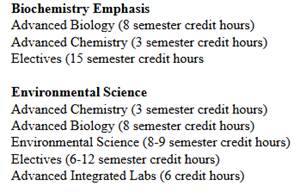
Advanced electives in physics and mathematics are highly recommended for those students planning graduate work in chemistry. For students interested in medicine, dentistry, teaching in public schools, graduate study in biochemistry, or chemistry-related areas such as pharmacology, toxicology and public health, a modified academic program may be followed. These programs, which are planned by the students in consultation with their academic advisor, are designed to give the student the academic background to pursue professional career goals.
For questions, please contact our chemistry faculty.
Offerings include a Bachelor of Science degree and a Minor in Chemistry.
Bachelor of Science Degree 57-66 Semester Credit Hours #
Core Requirements 34 Semester Credit Hours
- CHEM 121 – General Chemistry Laboratory I (1)
- CHEM 122 – General Chemistry Laboratory II (1)
- CHEM 131 – General Chemistry I (3)
- CHEM 132 – General Chemistry II (3)
- CHEM 321 – Organic Chemistry Laboratory I (1)
- CHEM 322 – Organic Chemistry Laboratory II (1)
- CHEM 331 – Organic Chemistry I (3)
- CHEM 332 – Organic Chemistry II (3)
- CHEM 333 – Instrumental Techniques of Biochemical Research (3)
- CHEM 341 – Analytical Chemistry (4)
- CHEM 421 – Advanced Integrated Lab I (3)
- CHEM 422 – Advanced Integrated Lab II (3)
- CHEM 431 – Inorganic Chemistry (3)
- IDS 324 – Junior Seminar (2)
Emphasis Requirements
Must complete one of the following emphases: biochemistry, environmental science, forensic science or professional.
Biochemistry Emphasis (for those students interested in health science) 31-32 Semester Credit Hours
- BIO 113 – Introduction to Cell Biology and Genetics (3)
- BIO 114 – Introduction to Cell Biology and Genetics Laboratory (1)
- BIO 123 – Introduction to Organismal Biology and Ecology (3)
- BIO 124 – Introduction to Organismal Biology and Ecology Laboratory (1)
- CHEM 441 – Biochemistry (3)
- MATH 121 – Calculus I (4)
- PHYS 111/PHYS 112 Introductory General Physics I and Introductory General Physics I Laboratory (4)
AND PHYS 121/PHYS 122: Introductory General Physics II and Introductory General Physics II Laboratory (4)
OR
- PHYS 211/PHYS 212: General Physics I and General Physics I Laboratory (4)
AND PHYS 221/PHYS 222: General Physics II and General Physics II Laboratory (4)
Must take eight or nine (8-9) hours of upper-level electives from BIO.
Environmental Science Emphasis (for students interested in environmental monitoring) 28 Semester Credit Hours
- BIO 113 – Introduction to Cell Biology and Genetics (3)
- BIO 114 – Introduction to Cell Biology and Genetics Laboratory (1)
- BIO 123 – Introduction to Organismal Biology and Ecology (3)
- BIO 124 – Introduction to Organismal Biology and Ecology Laboratory (1)
- BIO 414 – Ecology (4)
- ENSC 220 – Environmental Science (3)
- ENSC 221 – Environmental Science Lab (1)
- MATH 121 – Calculus I (4)
- PHYS 111/PHYS 112 Introductory General Physics I and Introductory General Physics I Laboratory (4)
AND PHYS 121/PHYS 122: Introductory General Physics II and Introductory General Physics II Laboratory (4)
OR
- PHYS 211/PHYS 212: General Physics I and General Physics I Laboratory (4)
AND PHYS 221/PHYS 222: General Physics II and General Physics II Laboratory (4)
Forensic Science Emphasis (Primarily for those students interested in criminalistics) 28 Semester Credit Hours
- BIO 123 – Introduction to Organismal Biology and Ecology (3)
- BIO 124 – Introduction to Organismal Biology and Ecology Laboratory (1)
- BIO 231 – Human Anatomy & Physiology I (3)
- BIO 232 – Human Anatomy & Physiology I Laboratory (1)
- BIO 241 – Human Anatomy & Physiology II (3)
- BIO 242 – Human Anatomy & Physiology II Laboratory (1)
- CJC 100 – Introduction to Criminal Justice (3)
- CJC 210 – Criminal Investigation or other approved CJC elective (3)
- CJC 350 – Criminology or other approved CJC upper-level elective (3)
- MATH 121 – Calculus I (4)
Professional Emphasis (Primarily for those students interested in obtaining graduate degrees in chemistry or related disciplines and/or obtaining employment at the BS level.) 24-26 Semester Credit Hours
- CHEM 300 or above (3-4 semester credit hours)
- CHEM 342 – Physical Chemistry I (3)
- CHEM 343 – Physical Chemistry II (3)
- MATH 200 or above (3 semester credit hours)
- MATH 121 – Calculus I (4)
- PHYS 211/PHYS 212 General Physics I and General Physics I Laboratory (4)
- PHYS 221/PHYS 222 General Physics II and General Physics II Laboratory (4)
Sample Four-Year Plan for B.S. in Chemistry #
| First Year | |
| Fall Semester CHEM 121/131 ENGL 111 MATH (121 or other) Gen Ed (HIST) KW 101 | Spring Semester CHEM 122/132 ENGL 112 EXSC 101 Gen Ed (REL) CL 101 |
Second Year | |
| Fall Semester CHEM 321/331 Gen Ed (ENGL/Lit) Gen Ed (Humanities) Emphasis Requirement Elective | Spring Semester CHEM 322/332 Gen Ed (ART/MUS/THEA) Gen Ed (Social Science) Emphasis Requirement Elective |
Third Year | |
| Fall Semester CHEM 341 IDS 324 Emphasis Requirement Emphasis Requirement Elective | Spring Semester CHEM 333 CHEM 431 Emphasis Requirement Emphasis Requirement Elective |
Fourth Year | |
| Fall Semester CHEM 421 Emphasis Requirement Emphasis Requirement Elective Elective | Spring Semester CHEM 422 Gen Ed (Social Science) Emphasis Requirement Elective Elective |
Chemistry Minor #
Requirements for a Chemistry Minor 19 Semester Credit Hours
- CHEM 131 General Chemistry I/CHEM 121 General Chemistry Laboratory I (4)
- CHEM 132 General Chemistry II/ CHEM 122 General Chemistry Laboratory II (4)
- CHEM 331 Organic Chemistry I/CHEM 321 Organic Chemistry Laboratory I (4)
- CHEM 332 Organic Chemistry/CHEM 322 Organic Chemistry Laboratory II (4)
- CHEM 300 or above (3-4 semester credit hours)
| Professional EmphasisAdvanced Chemistry (3 semester credit hours)Electives (15-17 semester credit hours)Advanced Integrated Labs (6 credit hours) Forensic ScienceAdvanced Chemistry (3 semester credit hours)Criminal Justice (9 semester credit hours)Psychology (6 semester credit hours)Biology (8 semester credit hours)Advanced Integrated Labs (6 credit hours) |
Fourth Year: Choose one of the following emphases: