Mission Statement & History
Our Mission
Kentucky Wesleyan College, spiritually guided by our partnership with the United Methodist Church, integrates liberal arts foundations with professional and graduate programs to form students for lives of purpose, leadership, and professional achievement.
History
The dream of an institution of higher learning held by Methodists from the first days of settlement in Kentucky came to fruition in 1858 when the Kentucky Conference of the Methodist Episcopal Church, South, voted to found a college at Millersburg. Classes began after the Civil War in 1866, and the first commencement, with a class of one, was in 1868. Begun as a training school for preachers, the curriculum expanded rapidly to include a solid basis of instruction in the liberal arts. The College introduced business classes, and by the 1880s, half of the alumni were employed as either teachers or businessmen.
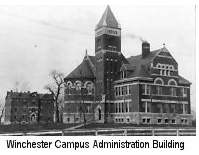
Millersburg, located on a branch line railroad, proved too remote for convenient student access. In 1890, the College moved to Winchester, in Clark County, which had two major rail lines. A fund drive resulted in money for new buildings, and the faculty from Millersburg settled into the hospitable environment of the College’s new home.
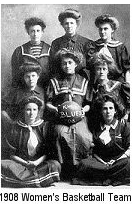
The early Winchester years brought many changes. In a pioneering step, Kentucky Wesleyan admitted women as students in the early 1890s, becoming one of the first institutions of higher learning in the Commonwealth to permit co-education. Intercollegiate athletics also became a part of the Kentucky Wesleyan College scene with competitions in ten, golf, football, baseball, and basketball, as well as a broad program of intramural sports for both men and women.
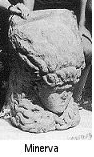
A Wesleyan tradition began in 1905 when fire destroyed the main building. A limestone ornament that adorned the facade fell to earth but remained intact. This bust of Minerva, the Roman goddess of wisdom, became a symbol of the Kentucky Wesleyan College spirit. Displayed in a prominent place on the Owensboro campus today, Minerva is a focal point for many Wesleyan student activities.
World War I saw the re-introduction of a military science curriculum at the College, patterned after a short-lived program of earlier years. With the return of peace in 1918, the College resumed its place as a leading liberal-arts institution. Under Dean Paul Farrier, Wesleyan developed a strong curriculum in sciences and humanities. Students enjoyed a new gymnasium for sports and physical education.
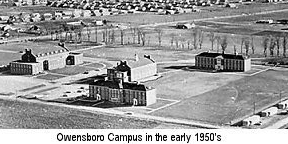
The Great Depression of the 1930s, followed by World War II, put considerable strain on the College. In 1950, the board voted to move the campus to Owensboro. The city of Owensboro, led by Wesleyan alumnus Talmage Hocker ’27, offered to raise $1 million if the College would come to Owensboro. The successful campaign led to Wesleyan’s move to temporary accommodations near downtown Owensboro in the summer of 1951. The College purchased a farm south of the city and construction began almost immediately. The new campus was operational in 1954.
Wesleyan secured full accreditation by the Southern Association of Colleges and Schools in 1947. Wesleyan graduates were making their mark in the graduate and professional schools of the region. Wesleyan expanded an already strong curriculum in business and liberal arts to include major programs in pre-professional areas. The College earned an enviable reputation for the many students sent to medical, dental, law, and graduate schools. The Order of the Oak and Ivy, founded in 1955, honored students with outstanding academic and campus service careers.
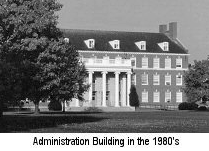
Construction continued through the 1960s with additional dormitories and included a new library in the 1970s and the Woodward Health and Recreation Center in the 1980s.
Kentucky Wesleyan gained national recognition in athletics when its men’s basketball team won national championships in 1966, 1968, 1969, 1973, 1987, 1990, 1999, and 2001. No Division II school has ever surpassed this record. A variety of sports teams won numerous regional and conference championships during this period.
In the 1990s, Kentucky Wesleyan College revised its mission statement to focus on preparing leaders for the 21st century. The College reaffirmed its commitment to the liberal arts and modified the General Education Program toward fulfilling the new mission. An F3 tornado roared through the campus on January 3, 2000. True to the Wesleyan spirit, the campus community worked together in the recovery effort to renovate and add buildings following the devastation.
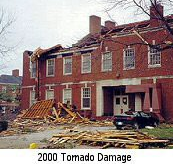
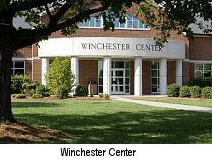
New facilities included Winchester Center, Yu Hak Hahn Center for the Sciences, President’s Home and Steele Stadium. The fourth floor of the Barnard-Jones Administration Building became the Center for Business Studies and Massie Hall underwent renovations.
In October 2015, The Rogers Foundation of Las Vegas, Nev., announced awards of over $10 million in scholarships over the next decade to college-bound students from Southern Nevada to Kentucky Wesleyan. The first students arrived in the fall semester of 2016.
In recent years, the College added four innovative academic partnerships:
- University of Kentucky College of Pharmacy Accelerated 3+4 Program
- University of Kentucky College of Medicine-Bowling Green Early Assurance Program
- Western Kentucky University Gordon Ford College of Business Preferred Partner Program
- Emory University Candler School of Theology, automatic admission and guaranteed scholarships for qualifying students
The Wesleyan community is guided by four principles which are a significant part of the College’s identity:
- We succeed with honor.
- We support one another.
- We compete with integrity.
- We love one another.